
Making sourdough easy
Learn from my mistakes

SPECIAL OFFER: GET MY SOURDOUGH STARTER!
If you will send a contribution in the paper mail to support my show and Substack, I will personally mail you a pouch of my dried sourdough starter that makes the bread you see below. You’ll have jar of bubbling yeast in one day instead of 1-2 weeks.
Send a contribution in any amount, and a note, to the following address.
Make checks out to “Disaffected Productions” please:
Disaffected Productions
89 Main St
Box 1027
Montpelier, VT 05602
Please allow a month to get your sourdough starter in the mail. It’s just me, one guy, manually doing the packing and addressing, and I pick up mail from the box twice a month. Thank you!-Josh
You guys know I like old shit. Old appliances, old cars, old people like me (and a lot of you).
Well, I like old methods, too, and not just out of romance. Turns out that most old—ancient really—ways of preparing food are objectively better. Better quality, and better for your health.
We moderns have been convinced since the late Victorian age that industrial-scientific methods are always superior. It’s so baked into our culture that it’s hard for most of us to think outside of it. Of course modern food is safer. Of course it’s better quality, right?
It’s not. That was never true. It simply wasn’t ever true. It just happened to be convenient for companies (and governments) who needed to sell us a bunch of bad quality shit in order to make their money. It’s what drove mid-century housewives to go for canned veg over fresh, and for TV dinners over home cooking. Oh yes, these things are convenient time-savers for sure, and they have a place; I’m not a puritan about it.
But the plain obvious truth is that none of it is as good for us as food made the traditional way, and most of it is actively bad for us.
Our ancestors throughout time weren’t idiots. They weren’t dying of food poisoning all the time the way we think they were. They had thousands of years to understand how to salt, how to dry, how to smoke, and how to ferment, to keep food fresh, and to make it more digestible and offer better nutrition.
Folks, the hippie-crunchies were right all this time. This approach to food isn’t from hippies, either. It’s from your great-great-great-great-great grandparents, and it lasted until the early 20th century. The hippies only rediscovered what people had been doing forever until the industrial revolution.
Let’s focus on bread. Modern store-bought bread is a nutritional and digestive nightmare. Because industrial profit-making demands quick turn-around times (three hours on average from mixing dough to the baked product), modern methods got rid of the time and simple processes that made bread more nutritious and tastier.
Dough conditioners, emulsifiers, extra gluten (for quick structure building), and preservatives are disgusting, and they’re not good for you. Modern hybridized wheat yields more, but at the cost of nutrition and digestibility. The old way of using natural yeast in a sourdough leaven, combined with longer fermentation times, produces bread that you can digest without trouble, that has more nutrition bio-available, and that won’t bother you as much if you are sensitive to gluten.
I used to believe gluten sensitivity was just a myth. After all, so many people claim to have “food allergies” that they don’t, because being a sick victim makes you special in our era. There’s a lot of that. But it’s not a myth, and many people have a hard time eating modern bread because it’s frankenbread. It’s nothing like what you ate 150 years ago.
Natural sourdough yeast culture and long, cool fermentation (rise time) produce bread with much of the gluten pre-digested, and many of the starches broken down into simpler sugars. This is the opposite of modern store-bought bread. You will often find that bread made this way doesn’t bother you at all. It’s not that you’re “gluten-sensitive,” it’s that your body is revolting against new and modern processes that introduce way too much of it through an inferior process that makes bread hard to digest.
I’ve only picked up sourdough baking again in the past few months after not doing it for about 15 years. I’m a mediocre bread maker; in a bit more time I’ll be a good one. But my mediocre loaves would blow your mind with taste and texture. Miles above anything you get at the store, and almost the equal of what you get at real bakeries that do it the old-fashioned way with sourdough.
You don’t ever have to eat frankenbread again, and me, I just refuse. We don’t have to live this way, or eat this way, or treat our bodies this way. What the 20th century did to our food was a crime, and we’re paying for it. Look around you. We all see what it’s done to people.
Some tips to get started
You don’t need to buy a scale, and measure the shit out of everything down to milliliters and grams. That’s the modern urban-industrial-tech mind infecting an old, natural process. I decided not to do it. I’ve read recipes, taken account of flour/water/starter ratios to have a base of knowledge in my head. But I’ve been teaching myself by trial and error. I want the knowledge in my hands, eyes, and nose.
And I’m getting it. I can take five minutes to whisk together flour, salt, water, and starter, gauge the right amount of water by feel, knead little, then put it aside to ferment at room temperature for a few hours. Then it goes in the fridge overnight (long, cold fermentation builds good bacteria and acid that start digesting the starch and providing a natural preservative effect). In the morning it’s ready to bake. Couldn’t be easier.
I strongly recommend you adopt this method. No scales. No millileters. This is just OCD in bread-making, and it’s nonsense. Your great grandmother didn’t fool around with this silliness. Neither do you have to.
Check it out:
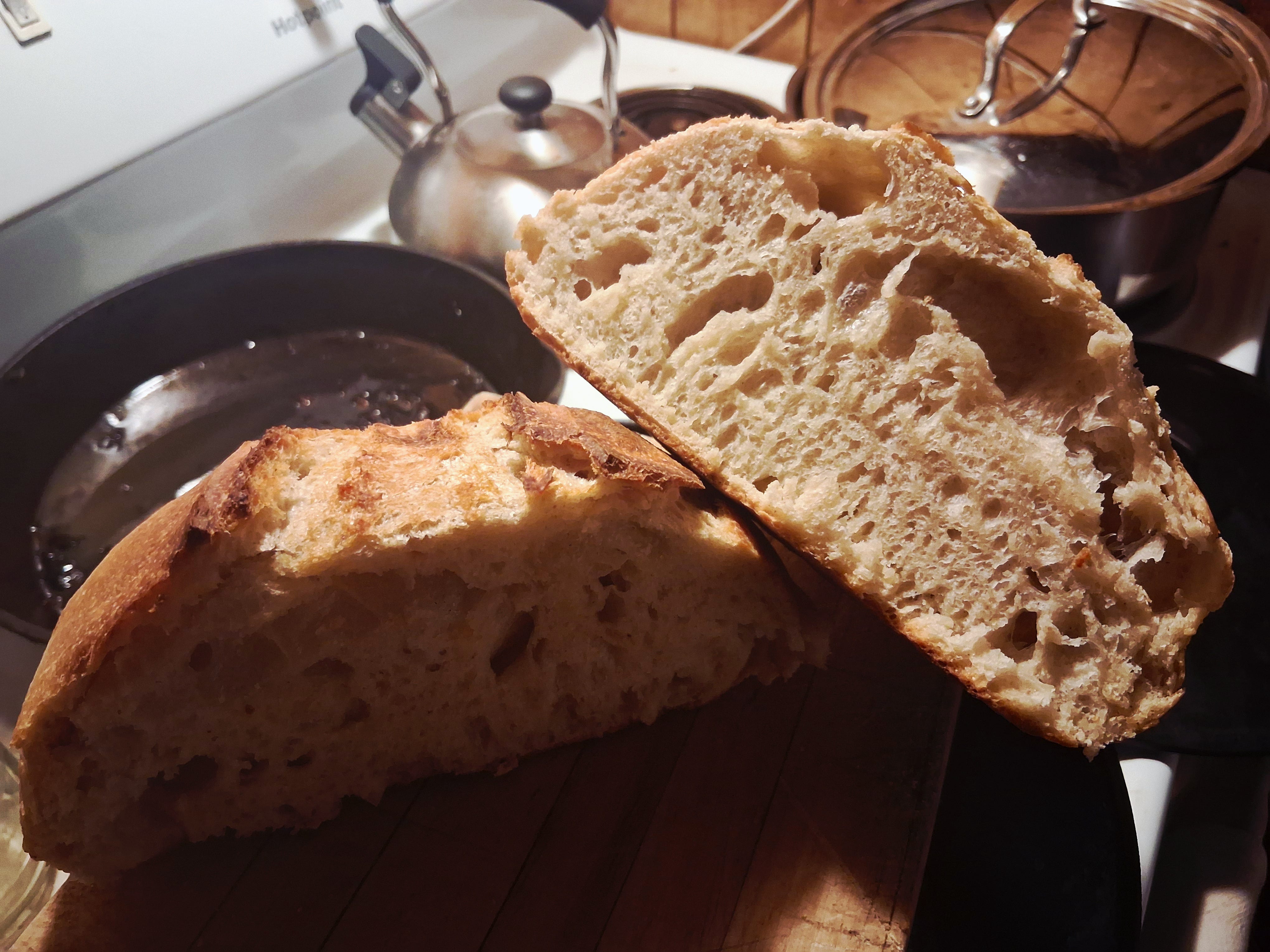
That’s my mediocre loaf. It tastes as good as it looks. You can do this, too.
For the starter:
—Whole rye flour, preferably organic and stone ground (yes, stone grinding does make a difference)
—Water
Mix up rye flour and lukewarm water into a thick paste in a glass jar. Cover loosely. Set on counter. Every day, discard half and refresh with flour and water. It will start bubbling in a few days. That first set of bubbles is a “false rise.” It’s not ready yet. It’s working out the easy, cheap (slutty) bacteria as it builds the right balance of yeast and stable bacteria you want.
After a week, you’re going to have a strong starter that doubles in size in a few hours after you feed it fresh flour. Boom. You’re done. It now lives in your fridge. You don’t have to feed it daily-that’s a myth. You just take it out and feed it on bake day.
You don’t need to keep hardly any, either. Even the scrapings at the bottom of your jar are enough to innoculate a whole new batch of flour and water when you feed it.
Why whole rye? It’s packed with more natural yeast and sugar than refined white flour, and it will build a starter more quickly. You can convert it over to white flour if it bothers you, but I just use it as is. It’s fine to have mixed grains in your loaf. My “white” loaves are always a little brown because I like the rye starter.
Avoid my mistake
I had a hell of a time getting my starter off the ground and couldn’t figure out why. Took almost a month, which is not normal. My problem was that I was heating it up too much and killing off the yeast. I underestimated how hot I was making the starter by putting in in a water bath on top of my fireplace stove. Duh.
Once I backed off that, it popped to life.
Your best bet is putting that loosely covered jar in the oven with the oven light on. That incandescent bulb makes the oven just the right temperature, about 80F. I’ve never seen an instance for anyone where this fails. This is also the perfect way to let your dough do its first ferment/rise for about three hours.
Sourdough yeast is not “quick-acting” like commercial packaged yeast. It takes two or three times longer for the same rise. You want this. Trading time means trading off the highest quality bread in terms of nutrition, taste, and texture. Relax. Plan ahead. Make your dough the night before.
Recipe
I’m not going to give you one, because I want you to actually learn how to do this. Following step-by-step recipes with achingly specific amounts is just like the Gen Z kids who “can’t” find their way to the grocery store in their own town without GPS. That’s brain rot. It’s nonsense. It’s learned helplessness.
Read some recipes online, watch some Youtube videos. Then get in there with your hands, eyes, ears, and nose. Make some bread. Learn what different doughs should feel like and look like. Every one of you reading can do this, and your great grandparents did automatically.
I’m doing it now. I use cup measures when I need to, knowing they’re not as accurate as weight. Who cares? If I can’t eyeball/feel the right hydration for the dough, then I haven’t learned anything. This is really, really basic stuff. Do you need directions for making a grilled cheese, or the spaghetti sauce you’ve been making for 30 years?
Here’s the Youtube account that inspired me and got me thinking about this. What he says is true, and it will change the way you think about breadmaking and a lot more when it comes to hearth and home. All his videos are interesting, and he’s got a lot on breadmaking.
Medieval Way On Modern Bread and Why It Makes You Sick
Have fun!
SPECIAL OFFER: GET MY 4S SOURDOUGH STARTER (Sour Slocum’s Sourdough Starter)
If you will send a contribution in the paper mail to support my show and Substack, I will personally mail you a pouch of my dried sourdough starter that makes the bread you see above. You’ll have jar of bubbling yeast in one day instead of 1-2 weeks.
Send a contribution in any amount, and a note, to the following address.
Make checks out to “Disaffected Productions” please:
Disaffected Productions
89 Main St
Box 1027
Montpelier, VT 05602
Please allow a month to get your sourdough starter in the mail. It’s just me, one guy, manually doing the packing and addressing, and I pick up mail from the box twice a month. Thank you!-Josh