
We're living in a game of Mousetrap
and we did to to ourselves

There is no reason to live the way we do. It is not a natural law. The complicated world in which we exist is not something that just “happened.” It is not inevitable.
It is a result of choices. Disconnected choices, yes. There’s no central mind that has created our society. There’s no one controlling cabal that has engineered the way we live, communicate, procure food, or any of that. Yes, there are powerful interests, legal and commercial, that influence our society more than you and I as individuals can influence it. But it’s not a conspiracy in the classic sense.
How do we live? We live in a scaled-up, real-world version of the classic children’s board game “Mousetrap.”

The game was one of my favorites, and maybe one of yours. It delighted children for several reasons:
—It teaches cause and effect by fun and implication, using your own hands
—It shows a model of how a machine works, always fascinating to kids
—Children can intuit the mechanics of the game. They can see that a ball has to roll down the slide just so or it won’t fall into the cup that’s connected to the lever, which is connected to the. . . .you see
Honest Mechanicals
“Mousetrap” is what I call an “honest mechanical.” Honest mechanicals are machines that can be observed, understood, and intuited. They show their workings right out in public; nothing is hidden from the hands or the eyes. Compare honest mechanicals to modern digital devices. Call those devices “black boxes.” By that, I mean an opaque device whose function cannot be observed, understood, intuited, or reverse-engineered by human senses alone. Black boxes (computers of various sorts) are not mechanicals at all. They don’t have levers or pulleys or counterweights, or sprockets, or escapements. They have invisible, immaterial states of magnetic orientation. You cannot see the works with your eyes, and the complexity of a chipset is beyond the human mind’s ability to grasp.
Trying to intuit the workings of your smartphone is as beyond your capability as it is to intuit the scale of the galaxy.
A piece of photographic film with a light sensitive emulsion that forms an image is an honest mechanical. The image is readable by the human eye.
A .jpg picture file is a black box. The image cannot be read or intuited by humans without another black box we call a computer.
A steam locomotive is an honest mechanical. Observe that you can understand how the machine turns heat into steam, and turns steam pressure into lateral force, and then translates lateral force into rotary motion, thus moving the train and its passengers along.
You don’t have to know the names of all the parts in a steam locomotive to understand how it works. You can see the steam and the push rods that take cylinder pressure and physically transfer it to spinning wheels.
You can intuit an honest mechanical. And if you have children, especially boys, I recommend that you introduce them to honest mechanicals. Show them how steam engines work. Show them a cutaway of an internal combustion automobile engine. Let them take apart a blender or a stand mixer to see how electric motors produce rotary motion.
Here’s an easy hands-on lesson you can and should do with your kids, starting at about age four. It doesn’t matter that the lesson uses “obsolete” technology. That is a benefit. This is a real-world lesson in physics and mechanics that teaches universal principles that can never be altered by whim or historical vogue.
Make a Record Player
Ingredients:
-A 33 and 1/3 long-playing record album. Use one that’s scratched that you don’t care about.
-A #2 pencil
-Construction paper
-Scotch tape
-A sewing needle
Method:
Form the construction paper into a cone and tape together. Then, tape the sewing needle securely to the small end of the cone. Think of an old gramophone with a needle attached to a brass horn-that’s what you’re doing. Or, think of this:
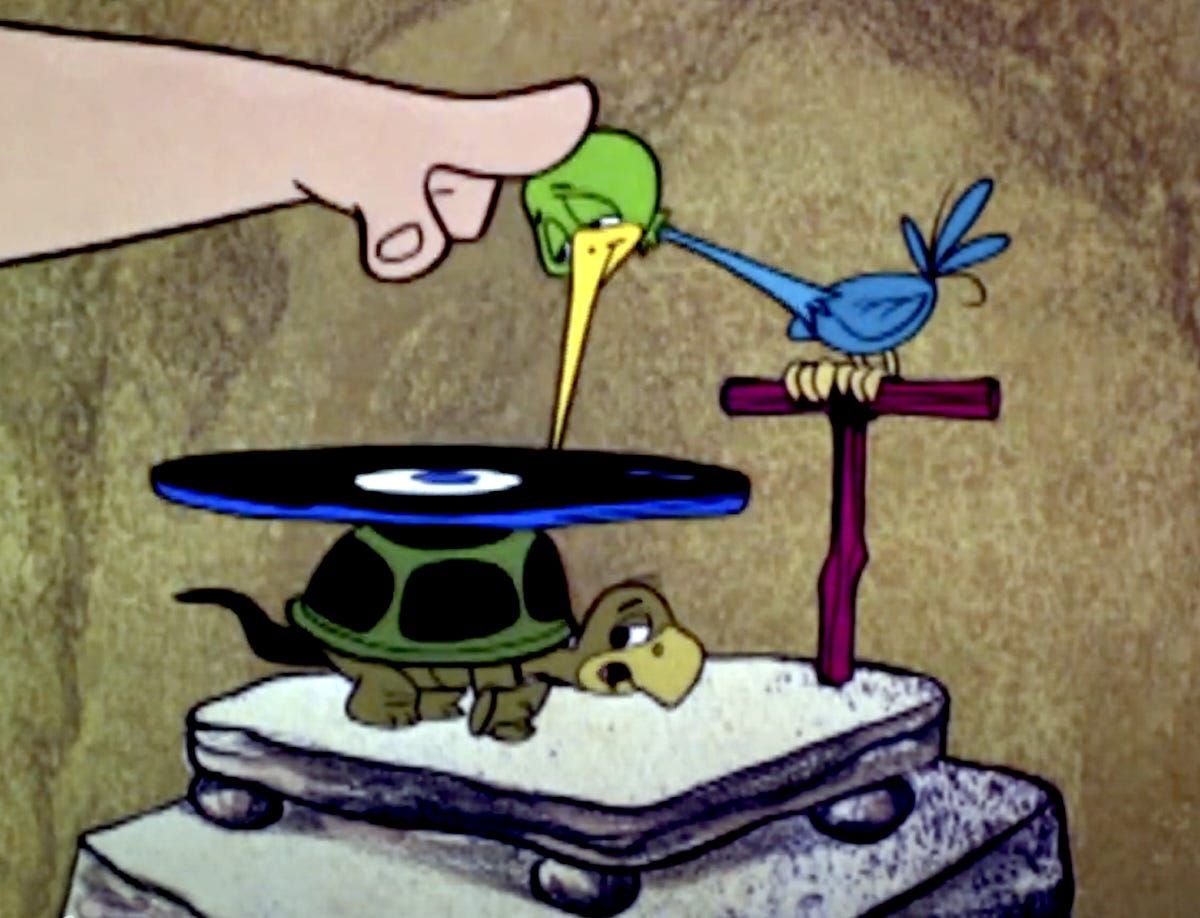
Then, put the pencil inside the center hole of the record. If it’s not snug, find another pen or pencil that fits snuggly. Spin the record like a toy top, and help your kid lower the needle-in-a-cone onto the guide groove at the edge of the record.
Magically, you’ll hear the sound on the record slightly amplified by the paper cone. Sure, it’ll be at the wrong speed, and maybe you won’t be able to parse the words. But you and your kid will immediately, intuitively, understand basic sound recording and reproduction. You will understand that auditory sound can be transcribed as a wave form that can take real-world, physical form in the bumps and pits of a record groove.
Most importantly, your child will understand the material world actually exists and that it is analog. That which he has only seen and heard reproduced by black-box inscrutable digital processing exists in the same three dimensions, made of material you can touch, that he exists in.
Your child will fall in love with an honest mechanical that teaches him foundational lessons about physics. About how the world actually works, physically, step by step. How a machine inside a sleek-looking case isn’t really a “black box,” but a series of levers and cogs and magnetos and cams and screws. And they all make sense that you can see with your eyes and touch with your hands.
1979, the Amtrak Station, Los Angeles
My family slipped away from Tully, New York, in the dead of night by means of my grandmother’s silver Buick Electra. The Buick was an honest mechanical. She told you that she had a V-8 through the distinctive muffled bass rumble from twin tail pipes. I used to close my eyes and listen to car exhaust to identify the number of cylinders in an engine In those days, you could tell a four, a six, and an eight apart by ear.

We left in the dark so the landlord wouldn’t know we were skipping out on the rent until we were already gone (he lived right across the road). You can see the house we left if you drive up Interstate 81 toward Syracuse from Cortland. Tully will be on your right. When the view opens to show you a hill with a lone house in the distance on a country road, you’ve found it.
We boarded the Amtrak to cross the country so my stepfather, a glassblower who specialized in making electrodes, could find a job. There was nothing left for a working class man in upstate New York in the 1970s.
It was a great trip in a sleeping car, my mother and stepfather and baby sister in the lower bunk, me in the upper. A rocking train will put you right to sleep. The dining car was pretty swell, too. It was a dining car, not the “food car” that rolls on Amtrak lines today where you pay $10 for a prepackaged hot dog that goes in a microwave. The dining car was an actual restaurant with a waiter and a cook.
On arrival in Los Angeles, my Uncle Lee and Aunt Sherry were waiting in a 1979 lemon yellow Cadillac Coupe DeVille. A Cadillac. I was going to ride in a Cadillac. This must be a dream. To a five-year-old boy from a poor working class family, this was almost unbelievable.
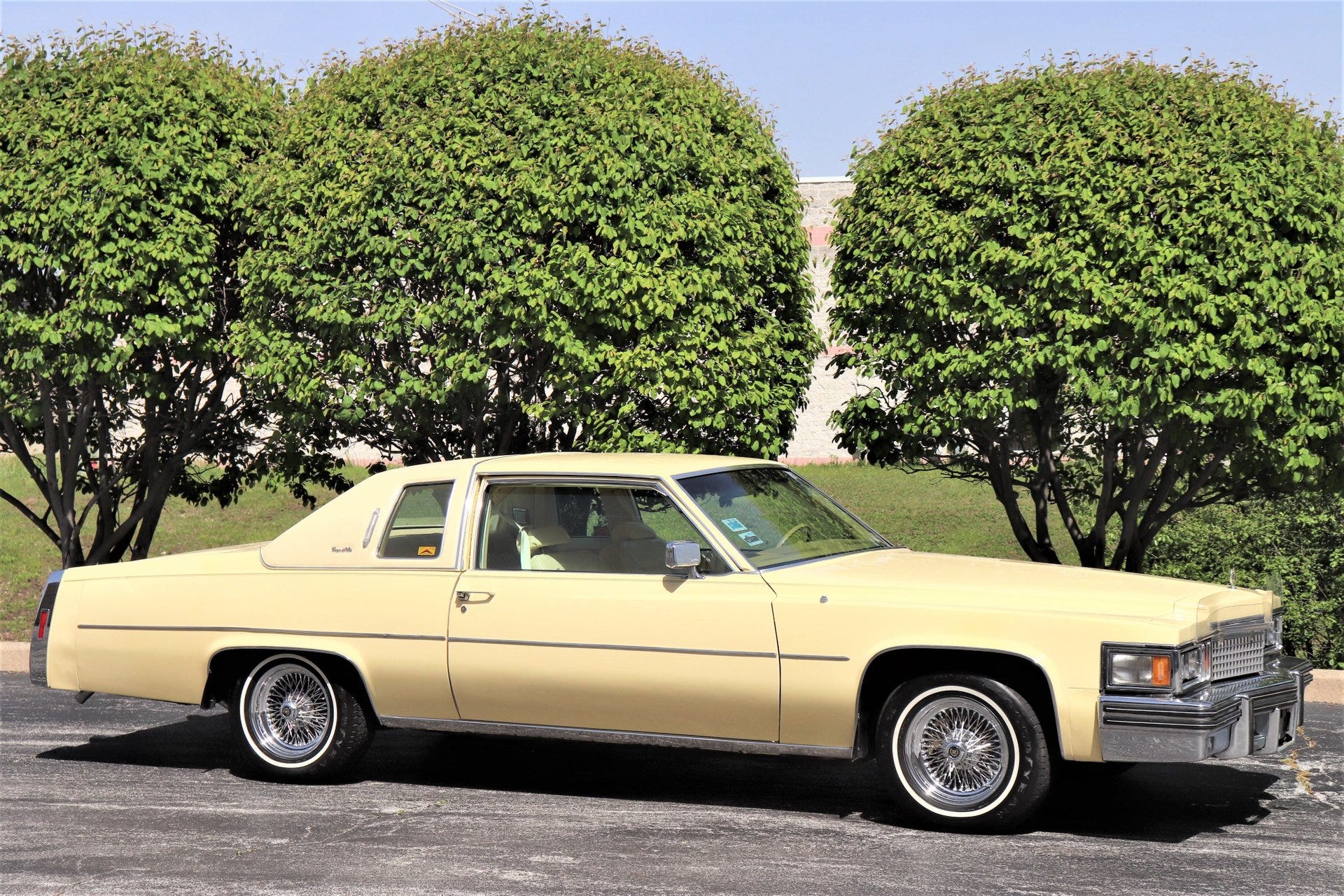
The trunk mechanism on my Uncle Lee’s Cadillac was my first introduction to what I would later think of as overcomplicated or dishonest mechanicals. It did this amazing thing I’d never seen before:
The trunk raised and lowered all by itself untouched by human hands. After my mother loaded the last suitcase into the family-of-corpses-sized trunk, the enormous yellow deck lid silently, slowly, crept downward. When the lid reached the latch, the mechanism slowed down to a crawl to give you a “soft and silent” latch.
Weird. How did this work? And why did it have to go so slow? Was there something . . . vulgar about having to hear a latch click? Would a driver be “scared” if the trunk just closed at a normal rate? These were new thoughts in my little boy brain, but I was anticipating questions that would crowd my mind in middle age.
Man and Machine
The Cadillac’s trunk mechanism gave me an uneasy feeling that I could not identify until decades later. Looking back, that feeling came to me first through one of my favorite stories from early childhood: the tale of John Henry.
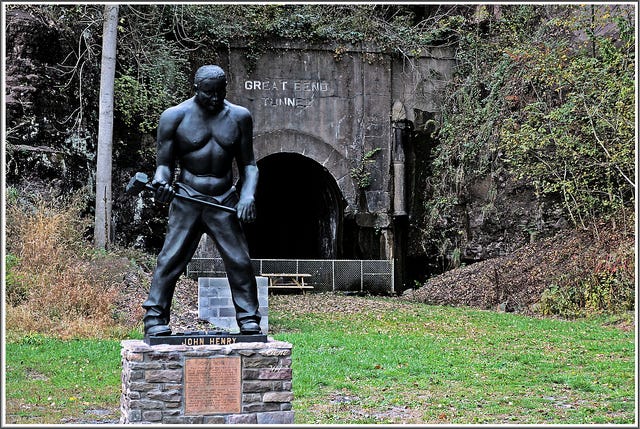
Legend has it that John Henry was a railroad worker, one of thousands of men who would be made idle by the newfangled steam-powered machinery. Henry entered a contest between him, a man, and a steam drill, to cut through a mountain to lay railroad tracks.
Determined to prove his strength and his worth, John Henry pushed himself against the steam engine until his muscle fibers tore and his body gave out. He died on the ground while the steam piston kept reciprocating.
The story fascinated me. And it horrified me. And it made me cry. At four years old, without having the words, I knew what John Henry was saying:
I am a man, and I lived.
John Henry is well and truly dead; the contest has been settled for 170 years. Humans today are surplus to machine requirements. “AI” is only the latest and most dishonest of the mechanicals and black boxes that have demoted us.
That’s what bothered me about Uncle Lee’s Cadillac trunk, I know know. The car was an “early adopter” of a machine ethos that is now universal. Everything today is buffered. When I want the windshield defroster in my Toyota, a black box chipset decides how rapidly the fan will turn on. And it has decided that it must inch upward softly, slowly, at the same pace the Cadillac’s trunk closed. I can’t flick a switch with a hard physical contact. Nope. I have to press electronic buttons and wait for a pre-determined algorithm to execute my command at the pace it has decided motorists can tolerate.
Look around you. Have you noticed how many machines buffer you from “sudden movement” or “sudden, startling light?” Even the goddamned interior roof light in my Toyota slowly dims and brightens when opening and closing the door. Lest too sudden an assault of photons strike me with an apoplexy.
God, it’s irritating. Not just for the time wasted, but for the assumptions that are revealed by the choices the engineers made. They obviously think that real-world immediate-response-to-tactile-commands is “gauche” or “like, weird?”
We live in a world of dishonest mechanicals and black box digitals. They hide their works with the primness of a tailor who makes skirts to hide the ankles of piano legs. No, isn’t true that Victorians covered furniture legs out of modesty hysteria, but it should be. Do you really want to live in a world where that’s not true?
None of our devices respond to direct tactile commands. You can barely find a switch or a toggle with an actual electric contact; everything is buried behind soft and mushy “touch surfaces.”
(And the sensation on the fingers is disgusting and vexing. The feel of the touchscreen is like the prick tease who brings you to the edge and then withdraws before satisfaction.)
These surfaces are dependent on an invisible digital algorithm that decides when, or if, it will execute the user’s command. I can’t rock my Toyota back and forth in the snow because the transmission joystick (another buffer) is connected to a computer that decides when it’s safe and appropriate to switch from drive to reverse. I cannot unstick my car in the snow despite its “advanced traction control” the way I could with a clutch and a mechanical stick.
We are buffered. For our safety. For our comfort. For our user experience. Because it just wouldn’t be prudent to let the operator decide when his machine performs the work for which he bought it.
I’m guessing that anyone under about 45 is rolling their eyes. That age cohort was raised in the age of dishonest mechanicals and buffered black boxes, and probably thinks this is not only normal, but necessary. I wasn’t exaggerating when I’ve noted that younger people have a new, never before seen reaction to technology that came along even one year before they were born: disgust.
No, not bemusement. Disgust. I can see it on their faces and hear it in their tones of voice. Something genuinely scares them about straightforward mechanical technology, and they process that fear through the social performance of disgusted mockery about “boomers.”
These are people who should have been given “Mousetrap” as children.
Our Modern Mousetrap
The board game Mousetrap works as a metaphor in two directions. It highlights the over-complicated as well as it foregrounds the direct and intuitively straightforward. I’ve talked about the good side, so let’s look at the downside.
Mousetrap is a classic Rube Goldberg contraption:
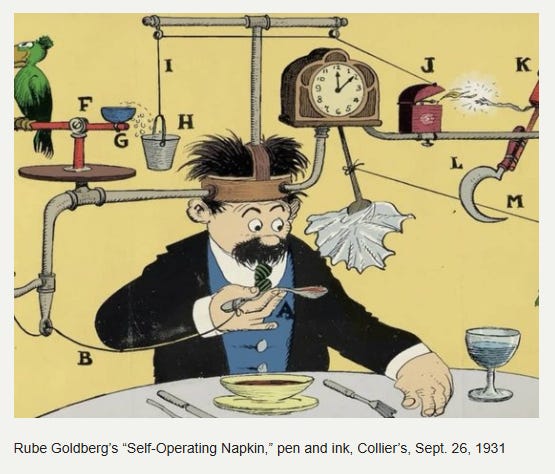
Rube Goldberg was an inventor, cartoonist, and many other things. He’s most famous for drawings like you see above in which a machine “solves a simple problem in the most ridiculously inefficient way possible.”
I have to explain that with a link because from Millennials on downward, younger generations know about zero things that happened even in the recent past. It’s unclear to me whether a young, modern reader would even recognize the concepts illustrated by a Rube Goldberg drawing.
Because our entire society is a Rube Goldberg contraption. We’re all living in a game of Mousetrap.
Another way of describing our contemporary economic and productive state is “precarious.” We live in an on-demand economy. Everything from our most basic foods to the electric power to the digital stream called the Internet on which we rely is in a state of “just enough, right now.” There is a web of indescribably complex dependencies; each strand of the web is connected to every other strand. Perturb or cut one strand, and the whole falls.
We saw this during the usurpation of our human dignity and God-given and Constitutional rights that we call “the Covid pandemic.” Remember not being able to buy toilet paper? For months on end? Remember “supply chain problems” that left mysterious gaps on store shelves that we’d never seen before?
On any given day, there might be no:
—Friskies brand canned cat food
—Eggs
—Any cat food at all
—Double A batteries (on which all of our remotes depend, on which most of our appliances depend even though it’s insane to make a ceiling fan dependent on a remote control)
—Any kind of high-fat dairy (yes, just high fat, whole dairy. The ‘fat free half and half’ seemed to do fine)
You probably have a motley list of your own of the strange, inexplicable staples you couldn’t buy.
Have you noticed that it hasn’t gone back to normal? Sure, it’s not as bad as it was four years ago. But “supply chain problems” have become permanent; I suspect a foundational web strand was cut and no one knows which one it is or how to re-string it.
Today I’m lucky if I can buy toilet paper in anything less than a 12-pack. Same thing with paper towels. And at least four times a year, even in the years 2025-2026, I’ll walk into the local grocery to see that the entire egg case is empty. Not just the specialty brands. All of them. Local eggs. National brand eggs. Store brand eggs. Not one single egg. And not one single explanation.
It’s “new normal.”
Everything we do is so precariously interconnected that when the next web string is plucked, we may have another real-world crisis. You cannot consistently log in to your bank account without having two computers on your person at every minute. Your password isn’t good enough. No. You have to retrieve your phone and enter onto your stationary computer a “one-time passcode” (one-time indeed; it’s every time) a special code displayed only on your must-have-in-your-pocket portable computer.
Everything is like this, but everyone is acting like this is the way things have always been. A friend of mine lost her Internet service over the weekend and could get no help at all from the company when she called. They refused to even confirm that they accepted that she was a customer of theirs, so they refused to give her any details about whether they could see an Internet service problem on her end.
Why? Because the only way she was allowed to prove that she was “Sally Smith, a known customer to ACME Internet Company,” was to log in to her email and speak out loud a “one time passcode” to the alleged human on the phone. Do you see the problem? You might not, because you think this is “normal” now.
How could my friend Sally log in to her email account to retrieve the “proof of human customership” conferred by the “one-time passcode” when she had no Internet?
(Before you ask, yes, there were signal-based and password-based reasons why she could not use her phone on cell signal to access this email account. If any reader was about to point this out as a “mistake” I made, that reader demonstrated that they have succumbed to this anti-logic. The reader was ready to blame her, and me, for “not being prepared” by not making sure that she had complete access to all her digital everything all the time with a phone that never experienced any problems. Such a reader reversed the blame onto the human when the reader should have questioned the insanity of the system.)
I could go on for multiple pages, hell, I could go on at book-length, about these things, but I understand that readers have limited patience. Let me restrict myself to just one further example of the real human cost in living in a Rube Goldberg machine where the humans are blamed for not living up to the machine’s requirements.
Have you ever had a car break down on the side of the road far from home? You pulled out your cell phone and called—excuse me, I’m sorry, you used the app no talking required or welcomed—for a tow. But what if your cell phone were dead? What if you left it at home? What if, like me, you live in a rural state where the majority of the land does not have consistent wireless phone service?
There used to be solutions both in human etiquette and in basic technology. I know this because I come from The Before Times (pacé Jenny Holland). In my youth, there were at least two choices.
1. A human would recognize that you were in a distress situation, and pull over to offer you a ride to. . . .(wait for it). . .
their house to use the phone or to the nearest. . .
Phone booth (I know-gross!)
Not today. Notice how the ubiquity of and forced dependence on cell phones has completely altered our thinking and decision-making. When we see a car broken down on the side of the road it doesn’t even blip our brains. It doesn’t occur to us that any motorist might be stranded without a working phone. And anyway, it would be weird and intrusive to stop and offer help. Or, God help you, a ride.
I used to stop for such people. I used to pick up female hitchhikers just because I didn’t want a dangerous man to be the one who stopped to “help” a woman in distress. Not a chance today. At best, a stranded motorist (especially a woman) would see this as “creepy and a violation of boundaries,” or just plain stupid (“like, I have a phone?”). At worst, it might be a trap; there are some lunatic broads walking around today who never would have seen the outside of a psychiatric unit in my day.
The human “technology” of helping each other in need and making do with what’s at hand is gone. We’re interconnected within black-box digitals and literally dependent on this fragile web. We’re in the Mousetrap and we pray that every piece at every stage stays standing because one perturbation brings the whole edifice down.
And to the degree that we’re entwined in the digital web, we’re severed from each other. We’re alienated from what used to be our intuitive common-sense about where we are in the world and how to get from place A to place B, and we’re alienated from each other. To even ask for “old-fashioned” help, like stopping at a gas station on a trip to ask directions to the next town, is treated like a social faux pas. Don’t you, like, even know about Waze?
We don’t have to live this way. This not an inevitable property of the universe. We did not have to arrange the world on the edges of infinite physical and conceptual precipices. But without intending to we did arrange it this way through countless barely conscious decisions that coalesced into this.
We are not machines, mechanical or digital. We are not “less than” the steam drill. We are not an inconvenience that irritates or embarrasses Apple’s operating system.
We are humans.
I am a man, and I live.
Josh here. Before you leave, would you consider financially supporting Disaffected? We have an option for everyone. You can chip in just a few bucks as a one-off, or you can subscribe for a very reasonable monthly price to support the work Kevin and I are doing.
—A monthly subscription is just $7 per month. You’ll be helping produce our show and the writing here, and you’ll get access to the Disaffected Discord chat server.
—There’s a discount for annual subscriptions; you get two months free with this option!
One-Time Support
—Want to throw $3, $5, $10 to our effort without subscribing? Thank you! Click here give in any amount you like.