
Let there be light
your beginner's guide to flame and kerosene light

To my happy surprise, a lot of people get interested in old-fashioned flame lighting when I talk about my passion for lighting and heating with antique kerosene lamps. I can think of a dozen people who bought lamps after reading about mine. Fun.
This is the beginner’s guide to kerosene lighting that readers have been requesting. I’m going to give a generous preview for free, but this is worth asking you to buy a paid subscription for if you want the whole thing. -Josh
It’s lamp season, my favorite time of year. When it gets cold, I fuel up four or five of the dozens of antique kerosene lamps I use to heat and light my house. The charm and warmth makes winter so much more bearable.
My hope is to convince you to give kerosene lamps a try. This is a complete beginner’s guide that will take you step by step through the basics. We start out with simple, inexpensive lamps, and gradually work up to higher-powered pieces. There’s something here for everyone. If you just want a pretty but simple lamp, I’ve got you covered. If you want to go deeper and get some of the fancier, brighter pieces, I’ll show you what you need.
But let’s go back in the past a little first. Fix a cup of tea and take a seat at the table with me.
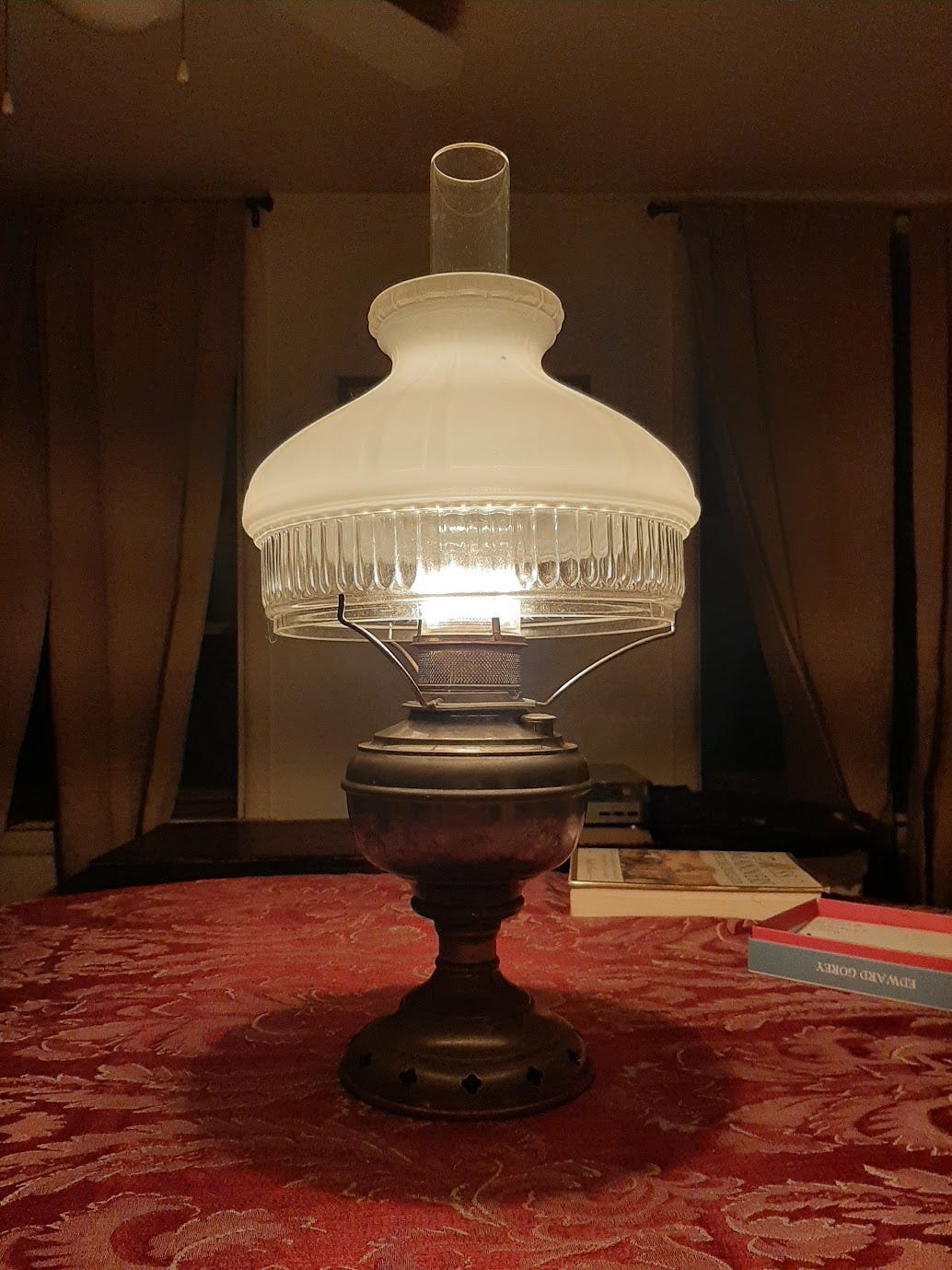
It’s inviting. You want to gather around with good people. If you sit down, you’ll find yourself staring into the flame, noticing the warmth it radiates. Real warmth (temperature) and metaphorical warmth (romance).
No electric lamps will make you feel this way. Some are very beautiful, of course, and the most charming use the original Edison-style incandescent filament bulbs. But they’re almost gone. Thanks to meddling safetyist government, we live under the ghastly glow of LEDs. Before that, it was compact fluorescents. And before that, it was the sickening, flickering off-green morgue illumination of the overhead fluorescent tube, the appropriate furnishing for the inhuman Brutalist aesthetic that has infected 90 percent of commercial office space in the U.S. since the 1960s.
We weren’t made to live this way or light this way. We did not evolve under unnatural artificial light stripped of whole swaths of the color spectrum, drained of infrared.
We evolved by the camp fire. For most of human history the communal fire was the only source of “artificial” illumination at night. Fire light is a first cousin to sunlight, the original illumination that gave rise to all life on earth.
Sometime after learning to husband fire, humans brought illumination indoors by bringing fire indoors. The first indoor heating and lighting fires were just stone pits in the middle of the room with a hole in the roof to let out the smoke. This was an awful design that filled homes with smoke that irritated and sickened. When you think about it, it’s incredible that it took until the 1100s in Europe and the British Isles before anyone figured out how to use a chimney to exhaust smoke and provide a good draft for a bright and clean-burning fire.
The fireplace with a properly constructed chimney was a huge advance over the open central fires, but it was still a poor heating technology compared to the cast-iron stove. Contemplate how much heat is wasted going straight up the chimney in a fireplace. If you wanted to be warm you could roast next to the fire, but you’d be shivering on the other side of the room. The Franklin stove was an innovation that captured almost all of the heat produced by the fire and radiated it into the room while using a chimney and flue system to provide good draft and proper ventilation.
Lighting followed a similar path of innovation. You could analogize it to the (I believe discredited) idea of “punctuated equilibrium” in biological evolution. Stephen Jay Gould proposed that evolution did not happen by gradual, steady accumulation of mutations that then fixed in the population. Instead, he thought evolution was largely stagnant, but “punctuated” by rapid bursts of change before settling down into a steady state again.
Whatever the truth in biology, lighting technology did proceed by punctuated equilibrium. First we had the main fire, then we had things like rush lights, a piece of straw, a rush, dipped in animal fat and set alight. They burned up quickly but they were cheap and readily made by things you had just lying around.
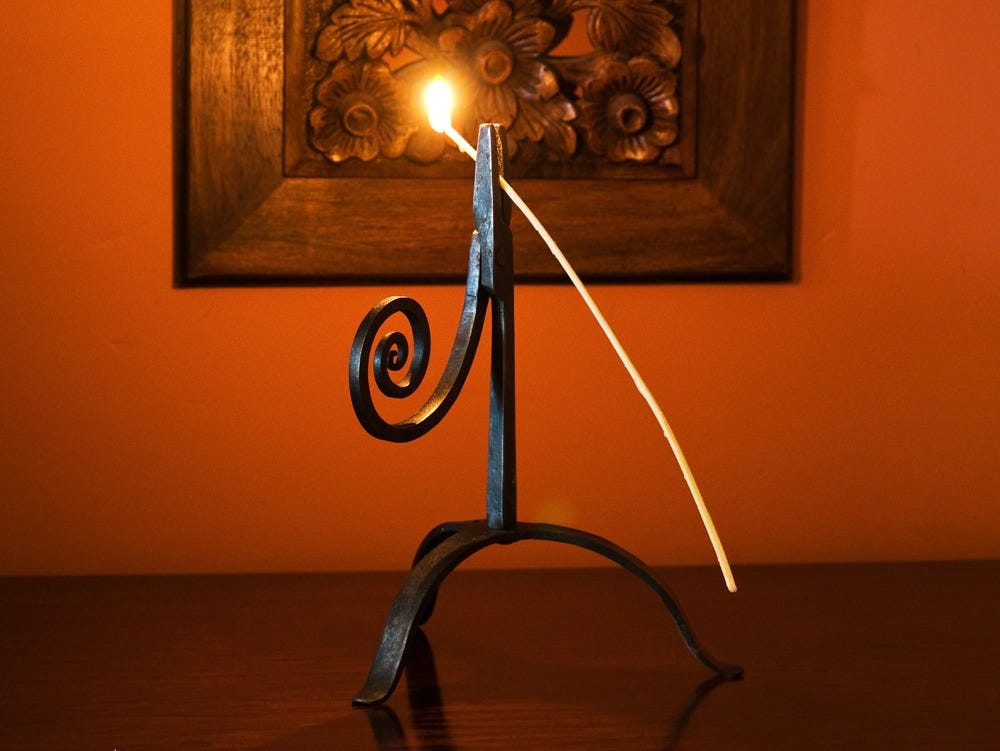
Candles were the next step. The simplest, cheapest ones were made with widely available materials that even common people had around: animal fat and a braided cord for a wick. The peasantry, when it had candles, made them out of the beef fat (tallow) or pork fat (lard) collected from the homestead. You heat the fat to liquid, insert a wick, and pour the fat into a mold. It cools and hardens and you have a candle.
But tallow candles burn dim and stink. In addition, animal fat melts at body temperature, so in warm weather or with much handling, tallow candles coat the hands in grease. Beeswax was the preferred fuel, but it was expensive; it was mainly the gentry and aristocracy who could afford to light with beeswax candles. They burn brighter and have no offensive odor.
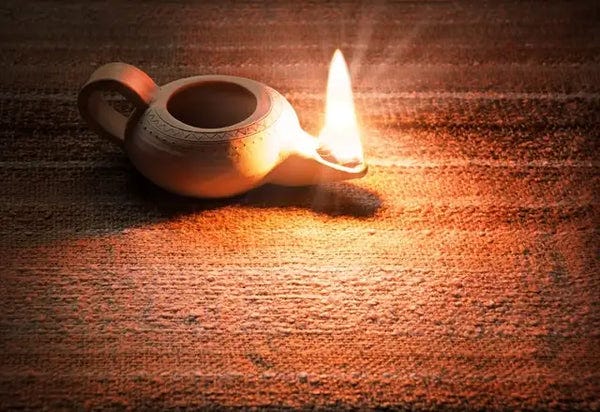
It’s not completely accurate to lay this out in linear chronological progression, though. Oil lamps have been used for thousands of years, but their use varied by geography. Probably the most famous example in popular culture are the Middle Eastern “genie” lamps.
You can see an example from antiquity here. These lamps work on the same principle as candles, except they use liquid oil instead of solid fat (usually olive oil). You pour oil in a shallow reservoir, then lay a cord or small strip of cloth with one end sticking out of a spout.
Europeans and early Americans had their versions called “betty lamps.”
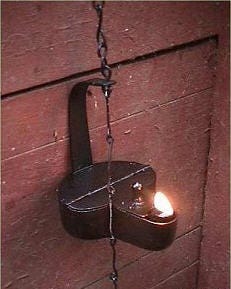
But all of these are weak sauce. Single flames are charming, but they don’t throw enough light to do much work by.
Ramshorn Studios has a neat history of whale oil lamps and some beautiful examples. Most had two wicks, putting out double the light. Whale oil also burned clean and bright without offensive odor. But it was expensive, and, obviously, supplies were limited. They eventually ran out completely.
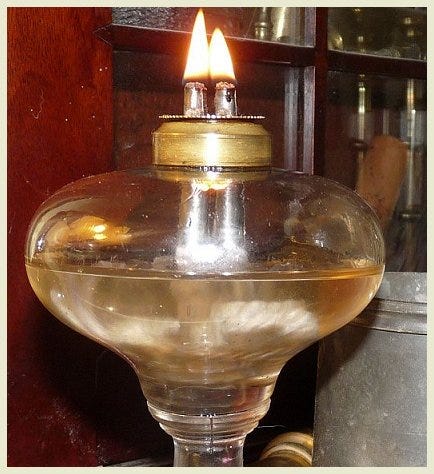
Enter Light, Exit Night: the introduction of kerosene
The introduction of commercially available kerosene was the largest advance in lighting technology in hundreds, perhaps thousands, of years. All the lamps I’ll discuss below and give advice for are kerosene lamps.
IMPORTANT—What you think of as an “oil lamp” today is actually a kerosene lamp. They were designed to burn kerosene and nothing else. Most modern people make the mistake of using deceptively marketed “lamp oil” or “lamp fuel.” This stuff should not even be sold or labeled as lamp fuel. It burns half as bright as kerosene, it stinks (this is why you think kerosene lamps stink; they don’t when you use the right fuel), and it clogs up wicks and leaves soot.
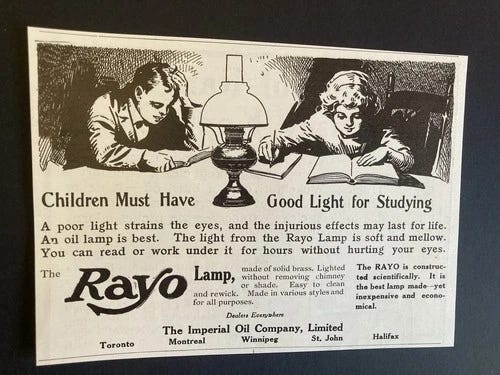
If you have any lamp oil in your house throw it away or burn it in some shitty outdoor tiki torch and then never buy it again. Replace any wick that has been touched by “lamp oil.” That’s usually just liquid paraffin wax (see below for disambiguation of U.S. and UK terms for “paraffin” and kerosene). Nasty stuff. That’s for candles, not lamps.
The first kerosene was made from coal and shale deposits; these are really “coal oil” lamps. The product first appeared around 1860. Production quickly took advantage of the newly discovered petroleum oil, and kerosene has been distilled from crude oil since that period.
In the Little House on the Prairie books, Charles and Caroline Ingalls discuss the “new-fangled” kerosene-fueled lamps. Before average people knew much about the fuel, there was a misplaced fear that it would “explode.”
Ma sat in her rocking chair, sewing by the light of the lamp on the table. The lamp was bright and shiny. There was salt in the bottom of its glass bowl with the kerosene, to keep the kerosene from exploding, and there were bits of red flannel among the salt to make it pretty. It was pretty.
—Laura Ingalls Wilder, Little House in the Big Woods
Fact: Kerosene is not explosive. It is flammable. There is a difference. Gasoline is explosive. That means that when it vaporizes (mixes with air naturally by evaporation), that gaseous vapor will explode if it reaches its flash point temperature. Automobiles take advantage of this property in gasoline engines.
What’s the difference between explosive and flammable? If you leave gasoline exposed to the air and light a match over the container, the vapor is going to explode and burn you badly or kill you.
Not so kerosene. It has no explosive vapor. There’s something called the “Amish match test” to determine if your clear fuel is gasoline. I can’t find reference to it online, but I’ve tested it, and it works. If you’re unsure if it’s gas or kerosene, take a teaspoon of the fuel and drop a lit match into it. Gasoline will produce a small explosion, but if it’s kerosene, the match will go out like you’d thrown it in water.
NOTICE: You, and only you, are 100 percent responsible for your own safety. I accept no liability for anything you do that gets you hurt that you may want to blame on my article. I regret feeling compelled to say this, but I do have to say it. 21st century Americans are so coddled, neurotic, and “victim-y” that otherwise sane people like to blame their misfortunes on “what I was told by someone and he should have warned me.” No. You are 100 percent responsible for you. I am zero percent responsible for you. Now, let’s carry on.
Kerosene does vaporize—that’s what kerosene lamps actually burn, the vapor—but only under specific conditions. The wick in a kerosene lamp is just a conductor, a woven and braided fabric to conduct the fuel up to the surface of the wick. A small amount vaporizes at that surface, and that’s what’s burning. This is why kerosene lamps grow brighter over a few minutes after you light them. The heat disperses and vaporizes more kerosene, thus making the flame brighter.
Kerosene is a wonder fuel. When it became the fuel of choice for lighting from the 1860s onward, it was correctly marketed as bright and free of offensive odor as you get from tallow and animal fats. Every time you take a commercial jet flight, you’re flying on kerosene. Jet engines run on a highly refined kerosene called Jet A.
I know, I know: You don’t believe me. You remember your grandma’s oil lamps, and they stank. That’s because your grandma was probably burning “lamp oil” unless she was old enough to remember what these lamps really want.
Also, many of you remember the stench of kerosene in your houses from kerosene heaters. There are several reasons why these stink:
The wicks are round and huge-you need to put out heat. That’s more kerosene being put through than you get in most lamps.
Most people never keep their heaters and burners clean. Old kerosene gets sludgy and stinky and sticks to the inside of the burner. When the device is lit that old sludge is heated up and aerosolizes giving you stink.
Many people burn adulterated kerosene because it’s cheaper.
What do I mean by adulterated kerosene? In the U.S., the government has fucked things up as you would expect. Uncle Sam believes he is entitled to tax the bejesus out of everything you need. Because kerosene can be run in some diesel engines (they’re very close distillates) in off-road vehicles, and because Uncle Sam thinks he’s entitled to tax all motor vehicle fuel, the government forces distributors to put pink dye in untaxed kerosene. Untaxed kerosene sold at gas station pumps in many states is much cheaper than the stuff I have to buy at retail hardware stores. The dye is there so that if a cop pulls you over he can see whether you’re “tax-dodging” by running untaxed kerosene; he can see the pink dye.
If you’re thinking to yourself “all that for the very rare occasions when a cop is going to ask to look in a gas tank?” you’re right. It’s absurd. This pink dye ruins the kerosene for lamp use. It makes it smell like diesel when it’s burned, it’s dimmer, and it quickly clogs your wicks. This is a way to screw the rural poor, who often rely on kerosene heaters. Because nobody gives a shit about “poor white trash,” and because kerosene use as heat is small today in the big picture. the government gets away with this and the laws are never challenged.
Never burn dyed or adulterated kerosene in your lamps or your heaters. Only use clear, undyed kerosene. It’s often labeled “K1” or “1K.” Same thing. You get it at your hardware store, sometimes at Walmart and similar stores. If you have a Tractor Supply in your region, they have the best deal on kerosene. They sell Crown Brand kerosene in 5-gallon jugs for $55 where I am in Vermont. This is just over $10 per gallon, 50 percent cheaper than I’ve found clear kerosene at any other store from any other manufacturer.
If you have a gas station in your area that sells undyed kerosene at the pump, that’s your best bet. It’s gonna be $4 to $7 per gallon. Buy a five-gallon jug and fill ‘er up.
Terminology
If you’re going to talk about or buy kerosene lamps, it pays to use the right words. This is an obsolete technology; modern people use the wrong words for lamp-related things, and this causes confusion. I’m not writing this to be persnickety, but because I want you to clearly understand what you’re dealing with. If you talk to sellers or experts into this kind of lighting, you need to know what the proper terms are for parts and procedures.
For enjoyment, to dispel confusion, and for safety, you need to know what you’re talking about.
Burner—This is a part of the lamp. It’s the metal piece through which the wick is fed. Burners come in many different designs, but they all do the same thing. Together with the lamp’s chimney, they provide the correct carburetion for a clean flame. This is the part of the lamp where you have a knob to turn the wick up and down.
Chimney—This is the tall, clear piece of glass that sits on the burner. It’s a literal chimney, just made of glass, unlike your fireplace chimney made of brick. The purpose of a chimney is not only to protect the flame from drafts, but to feed the correct draft (it’s carburetion) to the specific burner to give you a clean, bright light. The chimney is NOT a “globe.” That’s a common mistake. Chimney, not “globe.”
Flame spreader—a small metal piece that looks something like a large thimble. Center-draft and mantle-burning lamps require them (you cannot run these lamps without them, so make sure your purchase includes the flame-spreader). The cap goes in the middle of the burner inside a round wick. It does what it says-spreads the flame for a proper burn. If you have a gas cookstove, that iron black disk that sits on top of your gas burner is a flame spreader.
Font—This is what you probably call the “base” of the lamp. It’s the hollow, rounded portion that holds the kerosene. Same root word as “fountain.” It’s that from which the liquid flows.
Globe—The specifically shaped glass protector for an outdoor hand-held lantern. See the picture below. Lanterns use globes instead of chimneys. These two terms are not synonyms, and the parts are not interchangeable.
Kerosene—It’s kerosene, not “lamp oil” or “oil.” Kerosene is a specific chemical distilled from petroleum. The terms are not interchangeable.
Lamp—A device to illuminate inside the house. If it’s designed for indoor use, not to be carried out outside with a handle, it is a lamp, not a lantern.
Lantern—A device designed to be held by a handle outdoors to illuminate. This is a lantern:
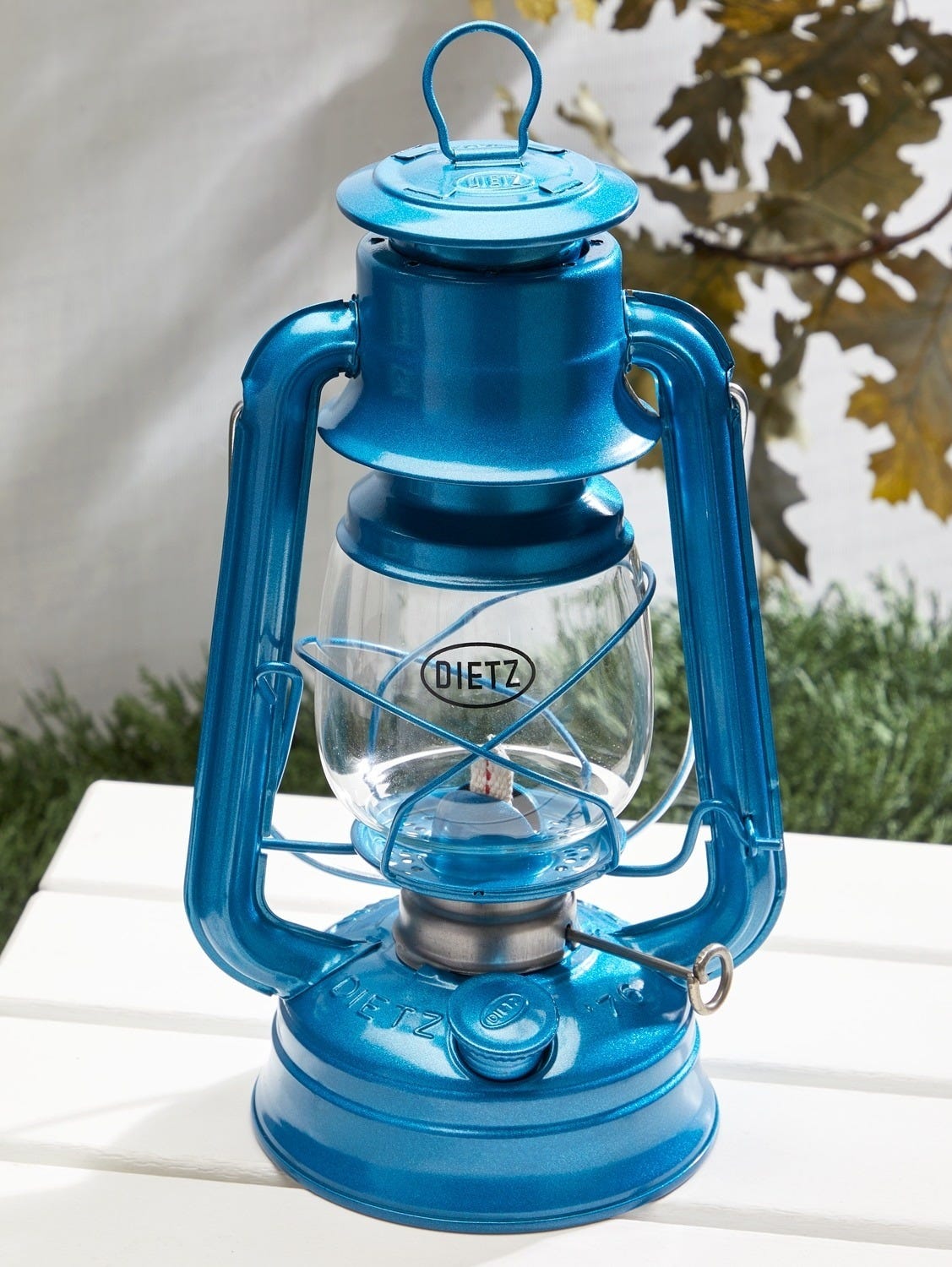
Note: The Vermont Country Store from which I got that photo is a great store and you should visit it sometime. But they are selling shitty paraffin-wax lamp oil along with these Dietz lanterns. Don’t buy it. Kerosene only.
Paraffin (disambiguation)—In the U.S., the name for this chemical is “kerosene,” but in the UK, what we Yanks call “kerosene,” they call “paraffin.” In the U.S., “paraffin” means liquid wax. Yes, it is confusing.
The rule: If a Brit describes a “paraffin lamp,” he means what we call a kerosene lamp. Don’t confuse these terms. Remember not to use (U.S. term) paraffin liquid wax in these lamps. Only kerosene.
Types of Kerosene Lamps: 1, II, III
OK, now we’re gonna start cooking with kerosene! I’m organizing this section from simplest and cheapest and most basic to more complicated. If you are buying your first kerosene lamp, I recommend you start with no. 1, the flat-wick lamp.
(Folks, this is where the free part ends. If you appreciate essays like this, please support my work with a paid subscription. After the paywall I take you through buying your first lamp, graduating to bigger ones, how to identify the parts, and how to troubleshoot.)
Keep reading with a 7-day free trial
Subscribe to Disaffected Newsletter to keep reading this post and get 7 days of free access to the full post archives.